
The Day
•The Morning Audit
After 1,500 weddings, I have learned to read a morning the way you might read weather coming in off the sea. Here is what tends to go wrong, and how to arrive at midday with everything still intact.

Emma Walkin
Founding Consultant
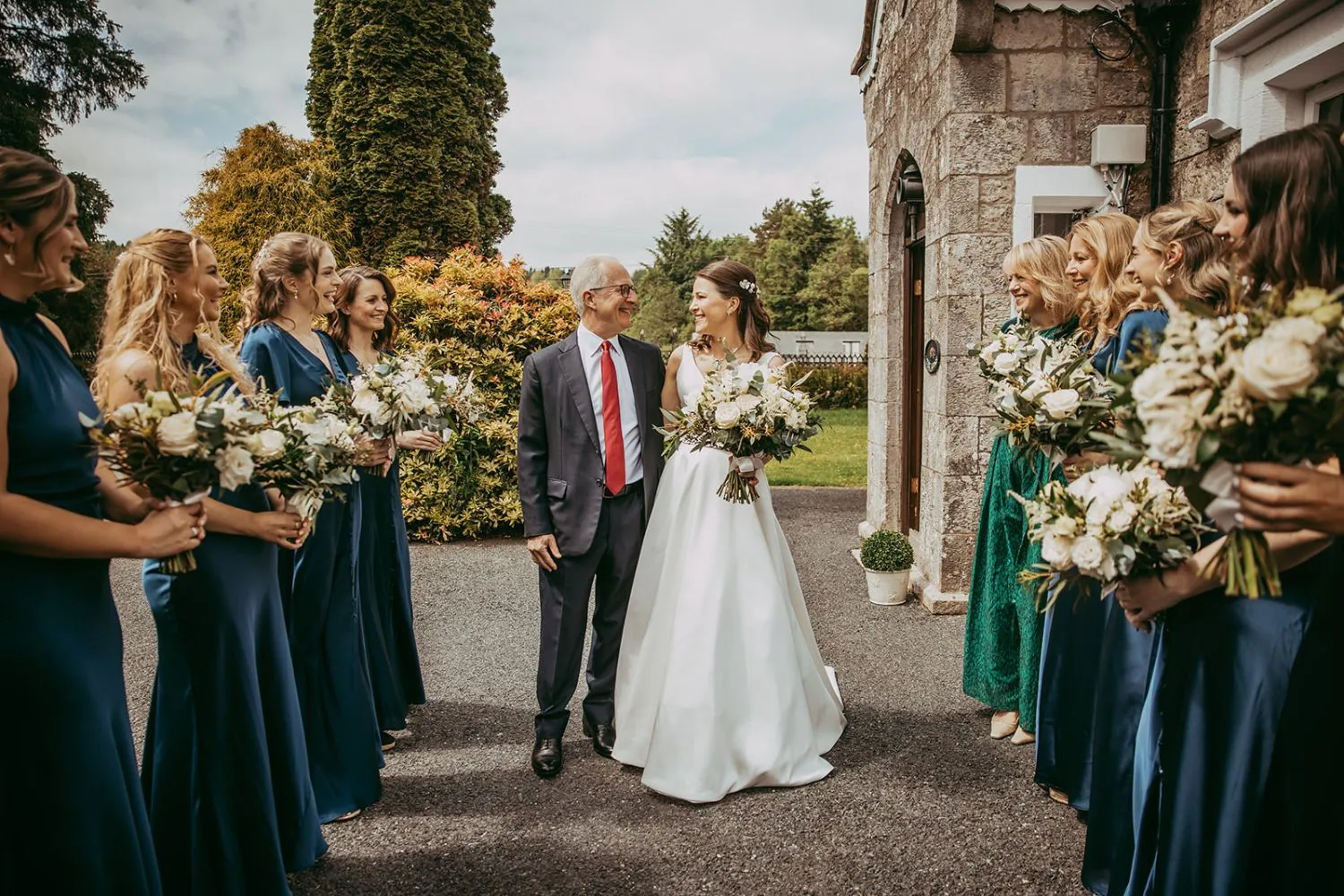
I have filmed over 1,500 weddings, and across all of them I have learned to read a morning the way you might read weather coming in off the sea. I have been in the room when it flows and in the room when it starts to quietly unravel, and by half ten I usually know which kind of morning I am standing in.
Sometimes it is the dress that gives it away. The buttons nobody practised, the corset nobody timed, the bustle that nobody thought about until it was already in their hands. Sometimes it is the bow tie. Sometimes it is the father who left for the church too early. Sometimes it is twenty minutes of Instagram content that nobody accounted for and nobody planned to lose.
It is always something predictable, and that is the whole point. These are not surprises. They are patterns I have watched repeat across hundreds of mornings, in every kind of venue and at every budget.
The morning is the most fragile part of your wedding day, and it is the part most couples think about last. You spend months on the venue, the menu, the flowers, and the morning gets a rough timeline in a notes app and a single message to the hair and makeup artist. What follows is what I have watched happen, quietly, in getting-ready rooms across Ireland. I am not telling you any of it to alarm you. I am telling you so that you arrive prepared.
The timing lie
Everything on a wedding morning takes longer than you think it will, and not by a little. Noticeably longer.
This is not a normal morning. There are more people in the room than usual, more conversation, more interruption, and more emotion sitting just beneath the surface of everything that gets said. Someone asks a question and the answer takes ten minutes. Someone needs help and the person helping disappears for longer than anyone expected. A five-minute task becomes fifteen, and a ten-minute delay at nine in the morning becomes a forty-minute problem by one in the afternoon.
You will not feel the first domino fall. You will feel it later, when you are trying to get into your dress and everyone in the room is watching the clock.
Hair and makeup
Hair and makeup is where most mornings quietly lose their time, and it rarely happens in one dramatic moment. It happens incrementally. A conversation that stretches, a touch-up repeated, a pause that runs longer than it should. Then there is the factor most couples are not aware of until it is happening in front of them.
Hair and makeup artists are no longer only doing hair and makeup. They are creating content while they work, and that means reels, transitions, before and afters. It is part of how they market themselves now, and I understand that completely. But every time they stop to film, your timeline pauses with them.
In reality nobody says anything. The artist is lovely, the atmosphere is warm, and the time is simply gone before anyone thinks to protect it.
Have the conversation before the morning. Something as simple as asking them to gather whatever content they need at the final touches rather than throughout the session. Most artists are professional and will respect it entirely, but if you do not say it, they will assume it is fine.
The dress
Every bride assumes getting into her dress will be straightforward, and in my experience it rarely is.
A zip dress takes ten to fifteen minutes once you account for everything around it. Buttons or a corset is thirty to forty minutes, and sometimes more. Bustles fail more often than anyone admits, and when one fails, nobody in the room tends to know how to fix it. Before any of that, though, there is a moment I have watched hundreds of times. The dress comes out, the room goes quiet, and everything suddenly becomes real.
That moment deserves to feel calm. When the logistics have not been thought through, it becomes tense instead: hands shaking, someone searching for a hook that was never packed, a button that will not close, a corset that takes three people and twice the time it should.
If nobody has practised getting you into the dress before that morning, you are solving a logistical problem in real time, under pressure, in the most emotionally charged part of your day.
Try the dress on at least twice in the week before the wedding. Assign one person to dress you and make sure they know exactly what they are doing. Practise the bustle until it is second nature, and pack a crochet hook and safety pins. Do not steam the dress on the morning either. Do it the day before. I have seen silk damaged on the morning by someone who was absolutely confident they knew what they were doing, and they did not.
The outstanding tasks trap
The morning of your wedding is not a production day, so let’s be honest here.
It is not the time to write your vows, to finish your speech, to add photos to table frames, to write place cards, or to complete anything that belongs to the week before. I know why it happens. The closer the wedding gets, the easier it is to push things back, because doing them early somehow feels premature. Then suddenly it is the morning and the list is still sitting there.
Everything you carry into that morning as an unfinished task will cost you presence. You will not be in the room. You will be in your head, finishing something that should have been done three days ago.
The morning has one job, and that is getting you ready to leave. Anything else belongs to the week before, and I would treat that as a hard rule.
The groom
I say this with complete affection, but groom prep is where confidence and preparation part ways most dramatically.
The bow tie first. I cannot tell you how many times I have stood in a room watching a group of grown men gathered around a phone, retying the same knot and getting it slightly worse each time. I once watched a groom send a taxi to a hire shop twenty minutes before departure to collect clip-on replacements, and it was not the first time I had seen it happen. Forty-five minutes lost to a knot means the easy, relaxed time with the lads before everything begins simply does not happen, and those are exactly the moments I would have been filming. Practise in advance or use a pre-tied one, because there is no version of the bow tie spiral that ends well.
Beyond the tie, the common failures are just as predictable. Shirts still in the packaging. A suit that has not been pressed. A missing belt, labels still attached, stickers on the soles of the shoes. And nobody tries anything on. I have stood in a room where the best man’s trousers were the wrong size, too small to button, and he wore a belt pulled tight over the gap and hoped nobody would notice. Wrong shirt sizes are just as common. These things are collected weeks in advance, assumed to be correct, and never actually checked, and by the time anyone tries them on it is the morning of the wedding and there is nothing left to be done.
Try on every suit, every shirt, and every piece at least a week before. If something is wrong, you have time to fix it, whereas on the morning you do not. Sort the outfit two days before and hang it properly. Lay everything out the night before so the morning is simply a matter of putting it on. Break in your shoes before the day as well, because blisters on the dancefloor are no fun!
Before leaving, three pockets in order. Left for the vows, right for the rings (or to Best Man), inside for the speech. Keep the phone in the jacket rather than the trouser pocket, because it shows in every photograph.
Parents
Parents are, in my experience, one of the most consistent sources of delay on a wedding morning. Not because they mean to be, but because they genuinely do not understand the timing pressure they are operating inside.
In both of the cases I am about to describe, the father left for the church without his daughter. Not out of carelessness. He simply did not know he was supposed to accompany her, because nobody had told him.
The first bride could not wait, so she left for the church on her own and met her father outside. The car journey she had quietly looked forward to, just the two of them before everything began, did not happen. She had never told him it mattered to her. She had assumed he already knew. The second bride waited, and her father came back and accompanied her, which is what she had wanted, but it had cost thirty minutes. A one o’clock ceremony became a half one ceremony, and everything that followed that day carried the weight of that delay. Same situation, two different decisions, and neither outcome was what anyone had planned for.
The moments you are picturing, the car journey and the quiet minute before you walk in, do not exist to anyone else unless you say them out loud. Tell your father exactly what you are expecting and when. Tell both parents their precise times rather than a vague window, and remind them again the night before. Do not assume anyone knows the plan unless you have said it clearly.
Children
Most couples tell me their kids will be fine.
They will not always be fine. Children are immediate, and their needs cannot be deferred. When a child is distressed, tired or hungry, every adult in the room responds to it: your mother steps out, your sister steps out, and the atmosphere shifts completely.
You are not only managing a child. You are managing the attention of every adult around you, and one child without proper support can quietly change the entire tone of the morning.
When I got married, we had our children’s Montessori teacher come in for the morning. Someone they already knew and already trusted. She fed them, kept them calm, and helped get them dressed, and it meant I could get ready without small hands pulling at me while I was trying to focus on myself. There is nothing more stressful than trying to get into your dress while a child needs something from you, and they will always need something from you.
Bring someone the children already know and trust. A family friend, a teacher, a nanny, someone who is there specifically for them and nothing else. It is one of the most worthwhile decisions you will make in the whole of your planning.
The domino effect
This is the thing I most want you to understand.
No single issue changes the flow of a morning. The accumulation does. Hair runs fifteen minutes over, and that pushes the dress, which cuts the first looks short, which compresses the departure, which means you arrive flustered, which means the ceremony begins under pressure. Each individual delay feels manageable in the moment. Together, they are not.
That is why the small things matter. Not because any one of them is catastrophic on its own, but because they never travel alone.
What calm actually produces
People ask me what I am looking for when I am filming, and the honest answer is calmness and space.
The real moments, the ones that matter most on film, are never manufactured. They are a glance between two people when nobody is talking, a parent watching quietly from across the room, a small gesture that nobody planned and nobody could have. Those moments do not happen in a rushed room. They happen when nothing urgent is pressing on anyone. When the morning has gone well, I can feel it in what I capture, and when it has not, I can feel that too.
The correct timeline
This is for a two o’clock ceremony twenty minutes from the getting-ready location.
Hair and makeup begin at eight. Allocate 45 mins per person for makeup. Hair 30 - 45 mins. Check these timings beforehand so there are no surprises! Photo and video arrive at half ten, and the stretch from half ten to noon is the magic window, the only genuinely relaxed part of the morning and the place where the real moments happen. Protect it, and do not fill it with tasks. Dressing runs from noon to one. Clear the room, slow everything down, and understand that this is where delays accumulate. First looks come between one and quarter past, and you should not rush them. At quarter past one the photographer and videographer leave ahead of you, because they need to be at the ceremony before you arrive.
From then until it’s time to leave is ideally the twenty quietest minutes of the day. A glass of something with your family, time to look back with your folks and ahead to the day in front of you. Most couples do not plan for it, and the ones who do are the ones who remember it. Departure is at twenty-five to two with nothing in your hands. The ceremony is at two.
If your ceremony is on-site, you gain roughly thirty minutes. Use it to start later or to build more space into the dressing window. Do not use it to fit in more tasks.
Before you go
I want you to be able to answer every one of these clearly before the morning arrives. Who is dressing you, and have you practised. Are the hair and makeup timings honest, with content creation accounted for. Do your parents know their exact times. Is childcare covered by someone the children actually know. Is every outfit sorted, hung, and ready. Are the shoes broken in. Are the rings accounted for. Do you have the green folder. Is everything that needed doing this week actually done.
If any one of those does not have a clear answer, address it now, and not on the morning.
The quality of your wedding day is largely decided before midday. I have watched it happen enough times to know that is true. Get the morning right and everything that follows has room to breathe. Let it slip and everything tightens, not catastrophically, but noticeably, in the room and eventually on film.